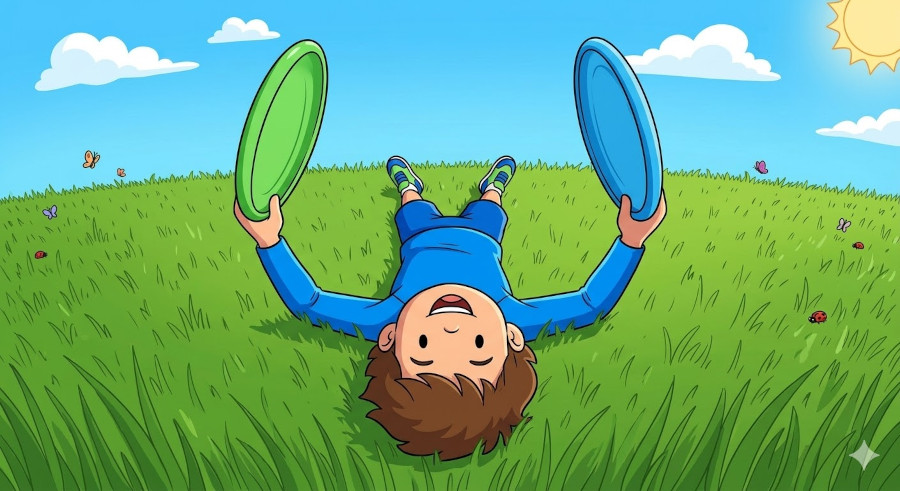
Every day. Not every week. Not when you feel like it. Not just on game day. Every day. That one sentence from Ben Wiggins is the entire philosophy of this book, and every chapter that follows is here to make it possible, no matter where you are or what the weather looks like.
Here is the reality of Ultimate Frisbee: most players only practice when they play. They show up on Saturday, throw a few warm up passes, play for an hour or two, and go home. Maybe they toss with a friend once during the week. Maybe they don't.
You picked up this book because you want more, and you want to accelerate your growth to reach your full potential. You want to throw farther, cut sharper, catch with absolute confidence using either hand, and play longer. You want the person guarding you to think, "Not this person again. Dang it!"
Solo practice is how you get there. It is the unfair advantage that separates the player who plateaus from the player who keeps climbing. Solo practice will strengthen your muscles, create insane muscle memory, and will keep you mentally engaged with Ultimate Frisbee when there is no game to be played.
You Are Joining a Tradition
Let me be upfront about something: this is not revolutionary stuff. Players have been practicing alone with a disc for as long as the disc has existed, and some of the best minds in the sport have built entire programs around it. Ben Wiggins created the legendary Zen Throwing program, a daily solo throwing routine that players around the world swear by. Click that link above to see all of the YouTube videos for Zen Throwing routine!
USA Ultimate, the sport's governing body, built its own official Skills Challenge around solo skills too, and we will visit that later in this chapter. So the tradition is real, and it is proven.
What I am adding to that ecosystem and community is simple: more exercises, more ideas, more things you can do by yourself with one or more discs to grow your abilities. And underneath all of it, one goal that never changes: have fun. If a drill in this book makes you smile while it makes you better, it is doing exactly what I designed it to do.
Why Games Alone Are Not Enough
If you can play the game, you are going to grow. Pickup games, tournaments, and league play are the fastest way to get experience and learn how the sport actually works in real time with other people - it is a team sport after all. And if you have a regular throwing partner, even better, I highly encourage finding a regular tossing partner. That combination of game reps and partner drills will make you a solid player.
But here is the problem. A majority of the time, you are by yourself. There is no game to play and no tossing partner with time available.
You have work to do or family to look after. The weather is bad. Your throwing partner is busy. The field is muddy. The game got canceled. Life gets in the way. And those gaps between games are where most players lose their edge, and where the best players sharpen theirs instead. That time adds up and how you interact with discs during this time really matters for improving game time abilities.
Two Discs and a Break Between Tasks
Let me tell you how this works in real life, my life for example. I spend a lot of time at the computer. Projects, emails, waiting for something to load or process. And during those breaks, I have a choice. I can scroll on my phone. I can watch a show. Or I can pick up a disc or better yet, two discs and focus on completing a few solo drills. You can also do these drills while listening to a podcast, multi tasking is great, but commit to working on your disc drills every single day for at least 5 to 15 minutes, hopefully longer.
I keep at least two frisbee discs near me at all times. When I have a five minute gap between tasks, I grab one or both and start spinning the discs on my fingers. The Hula Hoop Drill is my go to and all time favorite. The rim spins around my index finger like a tiny hula hoop, and every second it spins, the muscles in my finger are fighting to keep it going. I can feel the strain in my arm and I know the more I do this, the stronger my throws will be when I am on the field.
I spin both discs using both hands while watching TV. While waiting for the coffee to brew. Between meetings. While I am walking somewhere. Five minutes here, three minutes there. It adds up. And when I show up to the Sunday morning game at Nolte and rip a forehand that actually lands where I want it to go, that throw did not happen on the field. It happened because of strength and muscle memory built during solo time
Find Your Own Flow Each Day
You have probably heard of the 80/20 principle. In most areas of life, 20% of the work produces 80% of the results. Solo practice is no different.
You do not need to spend two hours a day doing drills. You need to find the handful of exercises that deliver the biggest payoff and do them consistently, even if it is a small amount of time each day. This book identifies many drills you can choose from.
Some of these drills take 60 seconds. Some take five minutes. None of them require a partner, a field, or good weather. All of them will make you better. What you do with a disc when you are alone echoes on the playing field during game time. Choreograph your own regular routine of disc building skills amongst and through your life, just work it in as best you can.
The Private Practice Ambidextrous Advantage
I highly encourage you to strengthen both your dominant and non dominant hand. If you are a righty, then make that left hand strong, and vice versa! How well can you throw and catch with both hands? This book has a strong focus on balancing your abilities for both sides of your body.
Most players are embarrassed to throw with their non dominant hand in public. You are at a pickup game, the disc comes to you, and your left hand (if you are right handed) is screaming, "Let me try!" But your brain says, "Not here. Not in front of everyone because it will most likely fail and mess up. Use the right hand instead." This is what happens to me at least.
Solo practice removes that pressure entirely.
When you are alone in your backyard, nobody is watching. Nobody cares if your left hand flick goes sideways. Nobody is going to judge you for wobbling a push pass. That privacy is freedom. And that freedom is where ambidextrous players are built and where your non dominant hand can fail over and over again UNTIL it doesn't!
The more you can do in private to strengthen your non dominant hand, the sooner that hand stops being a weakness and starts becoming a super strength. And when you finally unleash a lefty flick or backhand in a game and your defender has no idea what just happened, you will know exactly where that throw came from. It came from the living room. The backyard. The quiet reps nobody saw.
Here is something important to realize about working on your weaker hand, if you strengthen it, then you will catch more confidently with that hand in addition to being able to throw with it - however the catching benefits can be seen almost immediately when playing the game. Don't neglect your non dominant hand, do the opposite!
Gravity Is Your First Throwing Partner
One of the most powerful ideas in this book is simple: when you practice alone, gravity returns every throw!
Throw a disc straight up from your back? Gravity brings it right back down. Spin it on your finger? Gravity is the force you are fighting to keep it going. Throw it up a wall? The wall hits it and gravity brings it back to you. Do this many times per day, some days hundreds of times per day.
You do not need another person to get reps in. You need a disc and the willingness to pick it up and throw it in the air or up against a wall. Earth's gravity does the rest.
Wind is your Friend
Solo practice catching and throwing with the wind, during windy conditions is some of the best training you can do for yourself. The wind messes most players up considerably but if you learn to be more comfortable in the wind, it will dramatically increase your value on the field during games. Get out there and practice in the wind when you have time. The dividends are enormous. Get comfortable in the wind during solo practice first!
Injuries Prevented
Here is a beautiful truth about our sport: people play Ultimate Frisbee well into their 60s. It is a game of running, jumping, throwing, and catching, but because it is non contact, the disc can be a lifelong companion. What ends most playing careers is not age. It is injury. I am always working to avoid getting hurt, and solo practice is one of my best defenses. A steady routine of disc work keeps your body primed through the off season, so you arrive at game day stronger, looser, and ready. Fewer injuries, more decades of play. That is the quiet gift of solo practice.
What This Book Will Give You
Book 1 is entirely focused on what you can do by yourself. No partner required. No team. No field reservation. Just you and the disc.
You will learn drills you can do while lying on your back. Drills you can do standing in your kitchen. Drills for an open field, drills for a wall, drills for a windy day when everyone else stays home.
You will learn the science behind spin, the kinetic chain that generates power, and why a relaxed grip throws farther than a death grip. You will learn how to pull the disc 60 yards or more. You will learn how to throw with both hands WITH CONFIDENCE.
And you will learn how to build a practice routine that fits your life, whether you have 15 minutes or an hour.
 Legend: Ben WigginsBen Wiggins, creator of the legendary Zen Throwing program, said: "Throwing skill is best developed by throwing every day." Not every week. Not when you feel like it. Every day. And the drills in this book make that possible, no matter where you are or what the weather looks like. Click that link above to see all of the YouTube videos for Zen Throwing routine! I know this is in the beginning of this chapter, I included it again because it is such a great series of videos that is all about solo practice!
The USA Ultimate Skills Challenge
Here is something that validates everything we are about to do together. USA Ultimate, the governing body of the sport in the United States, created an official Skills Challenge program. It is a set of 12 solo challenges across four categories: Athleticism, Disc Fun, Game Skills, and Throwing.
There is a free website to sign into. There is a global leaderboard. The sport's own organization is telling you: solo skills matter. They matter so much that they built an entire program around measuring and ranking them.
We will reference these challenges throughout the book, and in the Discathlon chapter you will build your own version of it using the drills from every chapter. That is your measuring stick. That is how you track your progress from Beginner all the way to Legend. Please click the link above to see their skills challenge. You will not be disappointed!
Wrap Up
◆ Most players only practice during games. Solo practice is the unfair advantage that separates good players from great ones.
◆ Ultimate demands complete athleticism: throwing, catching, running, jumping, cutting, and thinking. Games alone cannot build all of those skills.
◆ The Hula Hoop Drill, spinning the disc on your finger, is the single highest leverage solo exercise for building flick power. Do it every day.
◆ Solo practice removes the embarrassment of working on your weak hand. Privacy is freedom.
◆ Gravity is your first throwing partner. You do not need another person to get reps.
◆ USA Ultimate's official Skills Challenge program validates solo practice as a core part of player development.
Action Steps
→ Keep at least one disc within arm's reach of where you spend the most time. Two is better.
→ This week, try the Hula Hoop Drill for just two minutes a day. Spin the disc on your index finger, then your middle finger, then switch hands. Time yourself.
→ Download the USA Ultimate Skills Challenge app and complete one challenge. Just one. See where you stand.
→ Pick one five minute gap in your day, a break between tasks, a commercial break, waiting for something to finish, and fill it with a disc in your hands.
Mentor's Closing
You do not become a legend during the game. You become a legend in the moments between the games. The quiet mornings. The five minute breaks. The backyard sessions nobody sees.
Every chapter in this book gives you something specific to do in those moments. Stack them up over weeks and months, and you will be amazed at what happens the next time you step on the field.
The disc is waiting. Let's get to work. :)